School | 2010 Admission Rate | 2011 Admission Rate |
Harvard | 6.9% | 6.2% |
Stanford | 7.2% | 7.1% |
Princeton | 8.8% | 8.4% |

Showing posts with label college admissions. Show all posts
Showing posts with label college admissions. Show all posts
Thursday, March 31, 2011
"Lottery schools" admission rates continue on downward trend
As reported in the Washington Post, admission rates declined slightly for some top-rated colleges.


Sunday, March 6, 2011
Extracurriculars are important
I believe that the core academic coursework should take precedence over almost everything else when school budgets are being tightened. But students lose out on so much of educational value when extracurriculars are cut due to lack of funds. Our local high school drama instructor explained it so well in describing how students benefit from participating in school plays.
Review Press: Talking high-school musicals with some of the area's directorsBest reason to join the musical:"I think being in a show makes you a stronger, more fearless person," he says. "Your skills improve; what you think you can do improves."I tell everybody, you should join the musical once, just to see what it's like," he says. "In my experience, more often than not kids say they wish they had joined earlier. It just seems to round out a person."How the musical changes kids:
It puts kids on the right path. "There are high standards to being in the play," he says. "You have to keep your marks up. If you're not coming to school, you're not (allowed) at rehearsal. Every director would like to say there's a giant emotional change and everybody's going to suddenly start reading epic Russian novels, but I honestly think that they get in the play and they like it and they don't want to screw up and get thrown out."
Friday, March 4, 2011
How much does tutoring improve SAT scores?
My friend Catherine, after reviewing various meta-analyses, says this:
Students get about 30 points on average (across reading/math), with 8 points of that going to reading & the rest to math.30 points applied to the 1600-point SAT math and reading sections is confirmed in this report.
I don't think anyone has ever looked at the high-end tutors (there are families in NYC spending $25K to $40K for a year of SAT prep for one child).
Now that I'm in the thick of SAT prep, I believe the meta-analyses.
I don't see how anyone can coach the reading section, which is fantastically sophisticated, much beyond the 8-point average gain researchers find.
And 20 points on math sounds right to me, too, though we're trying for more.
Test-prep programs generally include three elements: a review of test content, practice on test questions, and orientation to the format of the test. In 2009, in cooperation with NACAC, Mr. Briggs reviewed three national data sets and found the average effect of commercial coaching is positive, but slight. Test-score bumps were more in the neighborhood of 30 points (on a 1,600-point scale at the time), far from what some in the industry claim. He does point out that there may be specific programs that are more effective than others, but evidence to support that is weak.My unscientific extrapolated estimate for the 2400-scale SAT would be that tutoring provides an average 45-points bump.
Monday, February 21, 2011
Penn State bubble chart
I wish all colleges published charts like this. It would make things so much clearer during the muddy, anxiety-provoking college application process. Perhaps others disagree.
Penn State University Park is ranked 47 on the list of national universities by USNWR. Many state universities have similar "by the numbers" admissions standards, but most do not broadcast them in such a straightforward fashion as Penn State does.

Here is their explanation:
Penn State University Park is ranked 47 on the list of national universities by USNWR. Many state universities have similar "by the numbers" admissions standards, but most do not broadcast them in such a straightforward fashion as Penn State does.
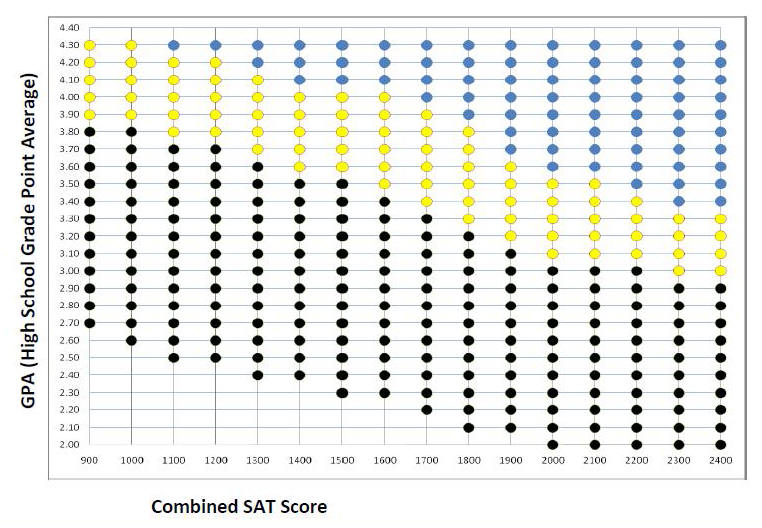
Here is their explanation:
To use the graph, plot the student’s cumulative high school grade point average and best combined SAT score from a single test date. The scale used is based on a 4.0 grading system that takes into consideration weighted grades. Based on the color of the point where the GPA and SAT score intersect, you can use the key below to estimate the student’s likelihood for admission to Penn State.
- BLUE - The student is likely to be offered admission to his/her first choice of Penn State campus, including University Park.
- YELLOW - The student is likely to be offered admission to a Penn State campus other than University Park. Additional review would be needed to determine eligibility for admission to University Park.
- BLACK - The student is likely to be offered admission to a Penn State campus other than University Park. Additional review would be needed for specific campuses and/or programs.
http://admissions.psu.edu/info/counselors/bubble_chart.pdf
Related: A CollegeConfidential discussion on this chart
Related: A CollegeConfidential discussion on this chart
Saturday, February 12, 2011
Some college admissions-related apps
The New York Times reports that The Fiske Guide to Colleges is now available for iPads. Although my son was lukewarm on it, I found the Fiske guide quite helpful. Some other college admissions related apps were featured in their story.
FutureU SAT — Kaplan’s new test prep video game is a free application that challenges players on the math, reading and writing sections of the SAT. Users can track their progress as they review geometric equations or subject-verb agreement. The free game works on both iPhones and iPads, with additional levels available for $1.99 each.
SAT Vocab Challenge — If you’re stumbling over obfuscate, obsequious and obstreperous, The Princeton Review offers an easy-to-use app that might just help. SAT Vocab Challenge focuses on definitions, synonyms and antonyms, but also includes timed quizzes to help prepare you for test day. Each volume of 250 words costs $4.99.
Peterson’s College Guide — Planning your college search list just got a little bit easier. Peterson’s Guide (free) has reviews and information on more than 4,000 colleges across the country. Can’t decide where to head next? Just shake your iPhone, iPod Touch or iPad and it will find one for you.
College Search App — Though it may not match the breadth of Peterson’s, the College Search App (99 cents) has some unique options that let users find institutions they may want to visit. Browse by region, type or athletic conference to find a school that may be a good fit.
College Savings — Worried how much your four years at Sarah Lawrence will cost? The College Savings application is an easy way for parents and students to compare just how much they’ll need to save to pay for college. The free iPad app compares how a user’s investments are likely to grow versus tuition forecasts to estimate how much you should be putting away before freshman year.
Saturday, February 5, 2011
How to prepare middle schoolers for college
Jay Mathews offers advice from some college admissions and education experts. I strongly agree with many of these suggestions.
1. Notice what they enjoy doing, and help them do more of it. Take your hiker on the AppalachianTrail. Have the kid who is addicted to the Food Network bake something for the county fair. Arrange for the singer in your family to audition for a local choir.
“It doesn’t matter whether the activity is athletic, service, spirit, leadership, journalistic or academic,” said Potomac-based educational consultant Shelley Levine. “Anything will do, as long as they enjoy the activity.” Northern Virginia-based educational consultant Shirley A. Bloomquist said, “If it is history, there are many local places to explore and discuss. If it is nature and/or geology, enjoy an outing to Great Falls Park. . . . A student of mine, now at Barnard, had a book club with her father over many years.”
Embracing a hobby or pastime is the key to career success and life satisfaction, said Zac Bissonnette, author of the recent college admission guide "Debt-Free U.” He advises middle-school parents not to “let yourself or your kid get caught up in the rat race of mindless achievement. Take time to think, and take time to play.”
2. Make sure your child knows that B’s are fine in middle school and that fun is important. Denise Pope, senior lecturer at the Stanford University School of Education and an expert on student stress, said each student needs a somewhat different message. The overachiever should be told, “You don’t need to do three different extracurricular activities in middle school to get into college,” she said. The less-motivated child needs to hear, “Yes, you can go to college, but first that means passing your courses in middle school.”[B's are fine for some kids, but what about the ones who could earn A's if they worked a little harder?]3. Enroll them in Algebra I in the eighth grade. Middle-schoolers must apply themselves to high-school-level courses, such as Algebra I. Many colleges count them as part of the high school grade-point average even though they are taken in middle school. Parents should also ensure that their children have finished Algebra I by the end of eighth grade. “I’ve known dozens of kids who would have been up to the challenge of high school level algebra/geometry in eighth grade,” said Philadelphia-based educational consultant David Ginsburg, but they “didn’t have the chance to take it.”
[Mathews responds to a reader's comment that readiness for algebra is a "a developmental issue, not an ability issue" with this:If you know of any research that supports your view, tell us about it. All that I have seen suggests it is much more a teaching issue than a developmental issue. We could have nearly every child ready for 8th grade algebra if we taught math properly in the lower grades, and had high expectations for all of those kids. Programs that take this seriously, like KIPP, have great success getting even disadvantaged children through algebra successfully by the end of 8th grade.]4. Insist they develop some practical housework skills. This won’t seem to them to have much to do with college, which is good. You can say that’s the way you were brought up (warn Grandma to cover for you if this isn’t true) and that is the way it is going to be. You don’t have to tell them that if they have to remember to get the trash and recycling out on the curb every Friday and make Saturday breakfast for their siblings while you go cycling, the coping skills they develop will be invaluable.
Kathy Kuhl, a home-school consultant based in Herndon, said, “We taught and re-taught our children time-management skills and life skills: washing clothes, cooking dinner and managing money.” Her kids were self-sufficient enough to juggle a college workload while doing all the other necessary chores of life.
5. Flavor family trips with a bit of college atmosphere. “On the way to summer vacation at the Outer Banks, have lunch at the University of Richmond’s student center, with its stately Gothic architecture and picturesque lake,” Bloomquist said.
6. Encourage children who are curious about the world to take a foreign language. This can be with CDs or at school. Most middle schools do not require a foreign language but nearly all offer some classes.“Chinese or Arabic would be two to consider,” Bloomquist said. “Colleges are increasingly international in nature. Twenty years ago, Yale had one in 50 international students. Today it is one in 11.”
7. Character counts. Encourage its development. “The college admissions process doesn’t necessarily screen for this,” Pope said, “but parents should be fostering good character traits along with health and engagement.” Just how you do this with sullen tweens and teens is not always clear. Being truthful and practicing what you preach is a good start.
8. Do everything you can to encourage reading. David Storper, president of Bethesda-based Prep U Tutoring, said, “The common denominator among the very best test-takers is a strong background with books. This is usually a habit that starts at a very early age. . . . The problem that many students face is that they are only reading assigned books from school, which can be less than inspiring.”
So, he said, give books to kids that suit their individual interests. “Do not pressure them to read it,” he said. “Just give it to them. If they read, great. If not, try again in a few weeks with a different book.”
Plan a weekly reading night during which everyone finds a comfortable chair in the living room, popcorn at their elbows, and enjoys a book of their choice for an hour or so. Leave some good paperbacks in the car. Talk about the books you are reading.
If reading becomes a habit for them, that will, of course, make them look good to colleges. But it will have even more impact on the quality of their everyday lives and their children’s lives and so on. It is never too soon to get started on that.
[I would add that a steady diet of light-weight fiction reading is not ideal. Background knowledge gained from reading nonfiction is essential in developing the critical thinking skills needed for college level work.]
Friday, February 4, 2011
College applications email account
Some good advice from NYT's The Choice for students applying for college financial aid.
Provide an e-mail address you actually check. The financial aid process is detailed, and we often need to contact applicants or their parents to fact check or request more information. If we can’t reach you, we can’t complete your award.
From the comments, some more advice:
Several parents on a related College Confidential discussion forum thread have suggested creating a college-only email address that parents can access so that Mom or Dad will be able to alert their applicant children to important notices. It may sound very helicopterish, but when thousands of dollars are at stake, it might be wise to start whirring those blades.— Sally Rubenstone, Senior Advisor, College Confidential
I confess I did this when my son applied to college: Yup, I wanted to make sure my son didn't miss any important news that might hit us in the pocketbook. There were times when he changed the email password so that he would be sure to be the first to learn decisions about acceptances, and that was certainly appropriate.
Saturday, January 8, 2011
"The most subject tests that any American college now requires is two . . ."
Good to know about this new development.
THE nation’s most selective universities have long required three SAT subject tests. But with the introduction of writing sections on the SAT and ACT in 2005, colleges have been gradually reducing the subject-test requirement.The New Subject-Test Math: 2 = 3 - NYT
This admissions cycle, Harvard has jumped on the two-test bandwagon, and Georgetown is “strongly” recommending three instead of requiring them. The most subject tests that any American college now requires is two, according to the National Association for College Admission Counseling. For 18 institutions, the ACT is good enough — no subject tests required at all.
Friday, January 7, 2011
High SAT scores are "just a given" for admission to top schools
I agree with Michele Hernandez and Mimi Doe of Application Boot Camp:
As we joyfully watch our students’ early acceptances come in, those getting into top schools had high standardized test scores! That’s just a given. Then comes the leadership, going above and beyond, etc.They may be biased, considering they are selling SAT tutoring services. However, my own observations are consistent with their advice.
Subscribe to:
Posts (Atom)