After reading Joanne Jacob's post on British schools advocating that their students read 50 books a year, I looked at the College Board's recommended reading lists. In the section below, the books in blue text are those likely to have been assigned in classes taken by an honors/AP-track graduate of our local high school. 22 out of 101 of the"101 Great Books" were assigned in high school classes, while none of the "Classic Cultural and Historical Texts" texts were.
You can see the entire book list after the jump.

Showing posts with label college preparation. Show all posts
Showing posts with label college preparation. Show all posts
Wednesday, April 13, 2011


Friday, March 11, 2011
College application essay camps
After finding this CollegeConfidential thread, I read a little more about college application camps. Here are a few examples.
A fun, invigorating, and productive week for high school juniors and those getting ready to apply to college….Over the course of the week, you'll brainstorm topics and ideas, write first drafts and incorporate feedback to write a second or third draft. By Friday, you'll have met the challenge of writing your essays, leaving you and your family to concentrate on other college decisions. Craft these pieces this summer and avoid first-semester anxiety as admissions deadlines loom.Location: Chicago
Course Fee: $1250.00
Overland’s College Essay Program offers rising seniors the chance to spend a week and a half on the Williams College campus producing the essay needed for their college applications. Each of our students will have the time to create, revise and polish his or her essay while enjoying the natural beauty of the surrounding Berkshires.
Location: Williamstown, Massachusetts
Cost: $1995 (airfare not included)
Mornings and some evenings will be spent researching colleges, small group discussions of the merits and myths of various programs, individual consulting time, reviewing application procedures for your colleges and department choices, developing an individual timeline calendar and writing and editing the initial drafts of your essays -- all under the guidance of our consultants. Afternoons will be spent touring college theater, dance and film and digital media departments in the Southern California area. A Q&A will be held with each department we tour.Location: Los Angeles
Tuition: $2812
Description: High school seniors and community college transfer students will have the opportunity to develop thoughtful, personal, powerful admission and application essays for colleges, universities, and other post-secondary programs.La Jolla, CAFee of $300
Friday, March 4, 2011
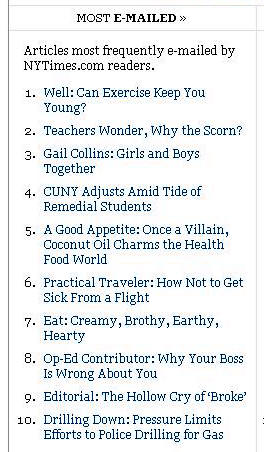
New York Times most e-mailed list this morning
The juxtaposition of numbers 2 (Teachers Wonder, Why the Scorn?) and 4 (CUNY Adjusts Amid Tide of Remedial Students) jumped out at me. Teachers are baffled by the anger directed towards them (or, perhaps more accurately, towards their unions) while New York City colleges are dealing with the reality that fewer than one-half of high school graduates are prepared for college. While teachers wonder, "why the scorn", I wonder if most people believe that teachers have a significant impact on student learning.

Related:
Saturday, February 5, 2011
How to prepare middle schoolers for college
Jay Mathews offers advice from some college admissions and education experts. I strongly agree with many of these suggestions.
1. Notice what they enjoy doing, and help them do more of it. Take your hiker on the AppalachianTrail. Have the kid who is addicted to the Food Network bake something for the county fair. Arrange for the singer in your family to audition for a local choir.
“It doesn’t matter whether the activity is athletic, service, spirit, leadership, journalistic or academic,” said Potomac-based educational consultant Shelley Levine. “Anything will do, as long as they enjoy the activity.” Northern Virginia-based educational consultant Shirley A. Bloomquist said, “If it is history, there are many local places to explore and discuss. If it is nature and/or geology, enjoy an outing to Great Falls Park. . . . A student of mine, now at Barnard, had a book club with her father over many years.”
Embracing a hobby or pastime is the key to career success and life satisfaction, said Zac Bissonnette, author of the recent college admission guide "Debt-Free U.” He advises middle-school parents not to “let yourself or your kid get caught up in the rat race of mindless achievement. Take time to think, and take time to play.”
2. Make sure your child knows that B’s are fine in middle school and that fun is important. Denise Pope, senior lecturer at the Stanford University School of Education and an expert on student stress, said each student needs a somewhat different message. The overachiever should be told, “You don’t need to do three different extracurricular activities in middle school to get into college,” she said. The less-motivated child needs to hear, “Yes, you can go to college, but first that means passing your courses in middle school.”[B's are fine for some kids, but what about the ones who could earn A's if they worked a little harder?]3. Enroll them in Algebra I in the eighth grade. Middle-schoolers must apply themselves to high-school-level courses, such as Algebra I. Many colleges count them as part of the high school grade-point average even though they are taken in middle school. Parents should also ensure that their children have finished Algebra I by the end of eighth grade. “I’ve known dozens of kids who would have been up to the challenge of high school level algebra/geometry in eighth grade,” said Philadelphia-based educational consultant David Ginsburg, but they “didn’t have the chance to take it.”
[Mathews responds to a reader's comment that readiness for algebra is a "a developmental issue, not an ability issue" with this:If you know of any research that supports your view, tell us about it. All that I have seen suggests it is much more a teaching issue than a developmental issue. We could have nearly every child ready for 8th grade algebra if we taught math properly in the lower grades, and had high expectations for all of those kids. Programs that take this seriously, like KIPP, have great success getting even disadvantaged children through algebra successfully by the end of 8th grade.]4. Insist they develop some practical housework skills. This won’t seem to them to have much to do with college, which is good. You can say that’s the way you were brought up (warn Grandma to cover for you if this isn’t true) and that is the way it is going to be. You don’t have to tell them that if they have to remember to get the trash and recycling out on the curb every Friday and make Saturday breakfast for their siblings while you go cycling, the coping skills they develop will be invaluable.
Kathy Kuhl, a home-school consultant based in Herndon, said, “We taught and re-taught our children time-management skills and life skills: washing clothes, cooking dinner and managing money.” Her kids were self-sufficient enough to juggle a college workload while doing all the other necessary chores of life.
5. Flavor family trips with a bit of college atmosphere. “On the way to summer vacation at the Outer Banks, have lunch at the University of Richmond’s student center, with its stately Gothic architecture and picturesque lake,” Bloomquist said.
6. Encourage children who are curious about the world to take a foreign language. This can be with CDs or at school. Most middle schools do not require a foreign language but nearly all offer some classes.“Chinese or Arabic would be two to consider,” Bloomquist said. “Colleges are increasingly international in nature. Twenty years ago, Yale had one in 50 international students. Today it is one in 11.”
7. Character counts. Encourage its development. “The college admissions process doesn’t necessarily screen for this,” Pope said, “but parents should be fostering good character traits along with health and engagement.” Just how you do this with sullen tweens and teens is not always clear. Being truthful and practicing what you preach is a good start.
8. Do everything you can to encourage reading. David Storper, president of Bethesda-based Prep U Tutoring, said, “The common denominator among the very best test-takers is a strong background with books. This is usually a habit that starts at a very early age. . . . The problem that many students face is that they are only reading assigned books from school, which can be less than inspiring.”
So, he said, give books to kids that suit their individual interests. “Do not pressure them to read it,” he said. “Just give it to them. If they read, great. If not, try again in a few weeks with a different book.”
Plan a weekly reading night during which everyone finds a comfortable chair in the living room, popcorn at their elbows, and enjoys a book of their choice for an hour or so. Leave some good paperbacks in the car. Talk about the books you are reading.
If reading becomes a habit for them, that will, of course, make them look good to colleges. But it will have even more impact on the quality of their everyday lives and their children’s lives and so on. It is never too soon to get started on that.
[I would add that a steady diet of light-weight fiction reading is not ideal. Background knowledge gained from reading nonfiction is essential in developing the critical thinking skills needed for college level work.]
Subscribe to:
Posts (Atom)