Showing posts with label education reform. Show all posts

Thursday, May 26, 2011

Where will "credential inflation" take us?

...large numbers of college students are studying little and learning almost nothing of lasting benefit...
Although large numbers of college graduates are perilously weak in basic skills, there continues to be a significant earnings disparity between graduates and non-graduates.  George Leef  points out that job opportunities for non-credentialed employees have been dramatically diminishing over the years.
Many firms now require that applicants have college degrees, even for work that calls for nothing more than basic trainability.
But how's that working out for employers?  "Credential inflation" means the human resources receptionist must have a college degree, whether it's in communications, marketing or any other number of majors that typically maintain painfully low standards for graduation.  Companies are paying a premium for a credential that in many cases is providing relatively little value.

With the much ballyhooed "education bubble" upon us, causing the cost of a college education to reach stratospheric heights, will employers began a shift to bypass the standard credentials that have been devalued by higher education's focus on social rather than academic learning?  Will they attempt to find new ways to judge potential workers?  While I'm not predicting this will happen soon, I can envision a future where motivated, intelligent young people will be able to take advantage of online learning and other affordable options to gain credentials that will attract attention from innovative companies.  Companies may find that bypassing the inflated credentialing system can be a good way to shake things up as they attempt to survive and even thrive in our changing economy.

Salman Khan's words come to mind.
To the point about replacing universities, I don’t think it’s going to happen any time soon.  But I think it’s an interesting idea and to think about that you have to realize that a university is about two things - it’s a credential and it’s learning.  I think Khan Academy is going to be able to really change how the learning part is done in a pretty significant way.  The credentialing part, getting your degree from Stanford or Harvard, that’ll probably be there for a little while.  I think if you fast forward ten years from now I mean it’s not going g to happen overnight   I mean this is social change happening. 10 years, 20 years, I think an employer would rather see your log from a site like Khan Academy where it doesn’t just get a 3.2 GPA in psychology it gets what you did , when you did it, how well you did it, how well were you able to help your peers, how consistently did you work,  wow, this guy worked 3 hours every day for 20 years on this stuff, this is a persistent kind of guy that I want working for me and we’ll be able to give people that type of analytics.  I think that can be a more powerful transcript than just a high level degree right now.
Found at Instapundit

Thursday, May 19, 2011

Should taxpayers only fund college loans to academically proficient students?

This idea is attractive, although I can see where many would consider it heartless and unfair.  It's clear that many universities will not impose standards requiring their students to be college-ready, so perhaps the federal government could help by placing restrictions on the money it lends.  It could potentially raise academic standards and save some people from themselves.  The student loan rate is up to 40% among some two-year colleges, and student loans cannot be discharged in bankruptcy.
What the Department of Education does now is to give loans to every college student who demonstrates financial need without examining evidence of academic ability and other criteria of credit-worthiness.
Our current situation reminds me of the problems associated with the federal loan home loan programs that contributed to the housing crisis, where credit standards were lowered so that loans could be given to people who otherwise could not afford home ownership.

In Minding the Campus, Jackson Toby asks us to consider this proposal. 
Insert a risk-assessment component into all future student loans that includes past academic performance in order to maximize the likelihood of loan repayment and minimize defaults that add to the national debt.

Wednesday, May 18, 2011

A few ideas on how colleges must change

Chronicle of Higher EducationAnd unless they rethink the way they do business, education experts say, some colleges will be forced to shutter.
"We're staring fundamental change in the face," said Stephen R. Portch, a former chancellor of the University System of Georgia. "Our system is bankrupt, and we've got to have a new model."...
To meet both the academic and financial challenges, colleges will have to rethink how they do business, Mr. Smith and others said. Among the ideas discussed: three-year degrees, year-round classes, online courses, adopting learning outcomes tied to real-world standards, and changing federal financial-aid policy to meet nontraditional students' needs.
What the conversation can't be about, said Nasser H. Paydar, chancellor of Indiana University East, is more money. "Universities just aren't going to get much more of it," says Mr. Paydar, who overhauled the budgeting process at his state university, putting spending decisions in the hands of deans and giving them incentives to be more entrepreneurial in seeking new sources of funds. 
Three-year degrees and more online courses seem to be very realistic changes that we'll see soon.

Thursday, March 17, 2011

Florida ending tenure for teachers

Florida Governor Rick Scott is expected to sign a bill ending tenure for new teachers.
The legislation, which positions Florida as a leader in the teacher tenure battle, would require new teachers to work under one-year contracts beginning in July, effectively ending tenure. As of 2014, contracts would be renewed based on evaluations, half of which would be tied to how students perform on assessment tests. The evaluations could lead to raises, or dismissals if teachers perform poorly two out of three years. Tenured teachers could opt into the merit pay system, but they would face the possibility of dismissal because of unsatisfactory evaluations regardless.
Teachers who work in troubled schools or in certain specialties, like special education, could earn more money under the bill. 
Details and funds for implementation seem shaky, with the schools assigned responsibility for developing some of the tests to be used for evaluating teachers.
Plus, they said, the bill comes with no money attached to develop the required tests or hand out merit raises. Once the bill becomes law, school districts will have until 2014 to develop tests. The state’s biggest standardized test, the Florida Comprehensive Assessment Test, will be used for some grades and subjects, but districts must develop separate exams for all other subjects in each grade, an expensive undertaking.
Florida House Approves Ending Tenure for New Teachers – NYT, 3/16/11

Monday, March 14, 2011

Kristof argues for higher teacher pay

In a NY Times editorial, Nicholas D. Kristof says we should raise teacher salaries.
We all understand intuitively the difference a great teacher makes....
One Los Angeles study found that having a teacher from the 25 percent most effective group of teachers for four years in a row would be enough to eliminate the black-white achievement gap.
Recent scholarship suggests that good teachers, even kindergarten teachers, increase their students’ earnings many years later. Eric A. Hanushek of Stanford University found that an excellent teacher (one a standard deviation better than average, or better than 84 percent of teachers) raises each student’s lifetime earnings by $20,000....
A teacher better than 93 percent of other teachers would add $640,000 to lifetime pay of a class of 20, the study found. 
Here's a problem.
Look, I’m not a fan of teachers’ unions. They used their clout to gain job security more than pay, thus making the field safe for low achievers. Teaching work rules are often inflexible, benefits are generous relative to salaries, and it is difficult or impossible to dismiss teachers who are ineffective
It appears to be a chicken and egg situation.  What should come first?  Should we pay all teachers more now, and then hope that reforms will help match pay with performance in the future?  Or, should we institute pay for performance standards now as the way to reach that end?  Either way is bumpy, but what can we actually afford?

And what about class size?  Increasing class sizes could free up money to pay top teachers the salaries they deserve.  Remember, the money has to come from somewhere and in this dismal economy taxpayers are just about tapped out.
Indeed, it makes sense to cut corners elsewhere to boost teacher salaries. Research suggests that students would benefit from a tradeoff of better teachers but worse teacher-student ratios. Thus there are growing calls for a Japanese model of larger classes, but with outstanding, respected, well-paid teachers.
ADDED:  Kristof is getting bashed in the blogosphere for insulting teachers with this:
These days, brilliant women become surgeons and investment bankers — and 47 percent of America’s kindergarten through 12th-grade teachers come from the bottom one-third of their college classes (as measured by SAT scores).

Wednesday, March 9, 2011

Arne Duncan, class size and champion teachers

David Brooks writes that Arne Duncan espouses the idea of "Gold Star" teachers.
Education Secretary Arne Duncan gave a superb speech in November called the New Normal. He observed that this era of austerity should be an occasion to increase productivity and cut the things that are ineffective. Duncan is a fountain of ideas to make more with less.
For example, he says, if we have to increase class sizes, we should put more kids in with the best teachers and then we should pay those teachers more to compensate for the extra load. Most of us parents would rather see our kids in a class of 30 with a great teacher than a class of 25 with an average one.
As a parent, I agree. But I don't think our schools can do this now, because they will not acknowledge that some teachers are better than others are.

Friday, March 4, 2011

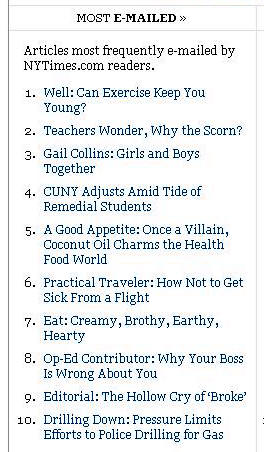
New York Times most e-mailed list this morning

The juxtaposition of numbers 2 (Teachers Wonder, Why the Scorn?) and 4 (CUNY Adjusts Amid Tide of Remedial Students) jumped out at me.  Teachers are baffled by the anger directed towards them (or, perhaps more accurately, towards their unions) while New York City colleges are dealing with the reality that fewer than one-half of high school graduates are prepared for college.  While teachers wonder, "why the scorn",  I wonder if most people believe that teachers have a significant impact on student learning.


Related:

Thursday, March 3, 2011

New York State mandate relief report weak on specifics

The Torch provides some analysis on the Mandate Relief Redesign Preliminary Report to Governor Cuomo.
Late yesterday, the Mandate Relief Redesign Team — or, more accurately, its coaches and trainers in the governor’s office — issued a report that essentially punts the issue back to … the team itself.
The report was couched as “preliminary,” promising quarterly updates, to conclude with a final report a little over a year from now. “Going forward,” the report promises, “the Team will continue to review recommendations proposed by Team members, state agencies, local governments, school districts and the public, and consider them for advancement.”
In the meantime, the hopelessly divided “Team” seems destined to spend a lot more time scrimmaging around the 50-yard line.  The Triborough amendment and employee benefits, to cite just two factors driving up local costs, were mentioned by the report in passing, only as “complex issues” requiring further study.
Employee benefits must be the single most costly mandate issue desperately in need of repair.  The report's idea for a new pension tier seems to fall short of what is really needed.
Unfortunately, the language of the report steers carefully clear of mentioning the main problem with the current pension system: the unpredictability of taxpayer-funded employer contributions; the huge, open-ended financial risks imposed on taxpayers; and the repeated success of unions in clawing back reductions in benefits before any employee comes close to reaching retirement age. Those problems can only be addressed through a fundamental break with the defined-benefit pension system—by shifting to a defined-contribution retirement accounts or a hybrid pension plan. The Cuomo administration is, as yet, clearly unwilling to go that far. But it’s still not shutting the door, either.

Wednesday, March 2, 2011

States look at 401(k) plans to replace pensions

Lawmakers and governors in many states, faced with huge shortfalls in employee pension funds, are turning to a strategy that a lot of private companies adopted years ago: moving workers away from guaranteed pension plans and toward 401(k)-type retirement savings plans....
Utah lawmakers voted last year to make a partial changeover to a 401(k)-type plan, following in the footsteps of Alaska, Colorado, Georgia, Michigan, Ohio and several other states, which offer at least some version of it.
In February, Kentucky’s Senate approved a full switch to a 401(k)-type plan, although the bill faces uncertain prospects in the House. In Oklahoma and Kansas, legislative committees will be studying the issue intensively over the next few weeks. Gov. Sam Brownback of Kansas has made it clear he hopes the state Senate will embrace some form of a 401(k)-type plan. Texas is also considering a switch. 
Pension Funds Strained, States Look at 401(k) Plans

Monday, February 28, 2011

Proposal from union leader to make it easier to fire tenured teachers

This seems noteworthy, a possible inroad into changing the "last in first out" policy of teacher employment.
Responding to criticism that tenure gives even poor teachers a job for life, Randi Weingarten, the president of the American Federation of Teachers, announced a plan Thursday to overhaul how teachers are evaluated and dismissed
It would give tenured teachers who are rated unsatisfactory by their principals a maximum of one school year to improve. If they did not, they could be fired within 100 days.
Cautionary words:
...only school administrators should create improvement plans for a poorly rated teacher; otherwise, unions might use the process to obstruct their removal.
Michael J. Petrilli, vice president of the Thomas B. Fordham Institute, a conservative-leaning education policy group, agreed. “In any other field,” he said, “this would be considered completely nuts that a manager would not have rights and responsibilities to evaluate their employees and take action.”
He added that the proposal did not address the most pressing issue: how to lay off thousands of teachers because of budget cutbacks without losing promising newer teachers.
“Her strategy of making sure all teachers who get a negative review will get a year and 100 days, it strikes me as a delaying tactic,” he said.

Tuesday, February 22, 2011

Why are people angry at teachers?

Whether it's warranted or not, many people are angry with teachers or, perhaps more accurately, with teacher unions.  Here's The Other McCain's take on the teachers in Wisconsin.
The unemployed, the under-employed and regular folks trying to pay their bills aren't likely to have a lot of love for people who (a) have jobs, (b) work at taxpayer expense, (c) get paid more money than the average taxpayer, and (d) go on strike because they don't want to pay a dime toward their own generous benefits.
Here's one teacher's perspective:
Then I discovered that Wisconsin teachers currently pay nothing--nothing!--toward their own pension plans, and pay only 6% of their salaries toward their health care plans. Yes, I pay more, substantially more, yet, I still don’t begrudge them their relative good fortune. However, when I discovered that Gov. Walker is expecting them to pay 5.8% (instead of 0%) toward their pensions, and 12% (instead of 6%) toward their health insurance, any sympathy I had for them instantly evaporated.
Found at Instapundit

Here's more. 

THE AVERAGE TEACHER PAY IN WISCONSIN IS NEARLY $50,000; THEY GOT A 4.7% RAISE LAST YEAR AND 21% OVER THE LAST 10 YEARS.

http://astuteblogger.blogspot.com/2011/02/teachers-in-wisconsin-make-more-than.html

Saturday, February 19, 2011

Do teacher unions want collaboration or conflict?

The same question could be asked of education reformers.  Although everyone seems to agree with the recent calls for civility, much of the rhetoric and actions we're seeing in the current debate is not amicable.

Some consider Wisconsin Governor Walker a bully for pushing an agenda to strip teachers of their rightful union rights.  On the other hand, the Governor says he will not be bullied by the teacher unions.

Big Government served up a list of antagonistic actions by teachers.  Here are a few:

• Last summer, Chicago Teachers Union President Karen Lewis told union members, “When we join forces together with our parents, our students and our communities and fight smart – well, they haven’t seen a fight like this. Not in a long time.”
•Lewis ramped up the rhetoric at a rally last fall, telling union members, “I’m not wearing earrings because we’re in a fight, a real fight.”
•United Federation of Teachers President Michael Mulgrew attacked New York City Mayor Michael Bloomberg, saying “It’s apparent the mayor shares his definition of democracy with Hosni Mubarak.”
•In a recent letter to union members, Indiana Federation of Teachers President Rick Muir repeatedly refers to the state’s education reform efforts as a “war.” “Make no mistake about it,” Muir writes, “we will lose the war if we sit back and do nothing.”

It was disheartening to see all the negative posters on display during the teachers' march on the Wisconsin legislature.  Ann Althouse posted photos here and here.

Thursday, January 13, 2011

New Jersey Governor Chris Christie - role model for education reform

It sounds good to me.
And on Tuesday, the governor, a Republican, used his State of the State address to push his education agenda further by calling for an end to teacher tenure, on top of his support for merit pay for teachers based partly on student achievement and adoption of a voucherlike system that would give students in low-performing schools other options.
Michelle Rhee's new organization, StudentsFirst, is providing policy support for Governor Christie's education initiatives.

Governor Thrusts New Jersey to Fore of an Education Fight - NYT