Saturday, March 5, 2011

Proposed budget cuts at our middle school

PROPOSED MIDDLE SCHOOL CUTS
All schools have been asked district wide to reduce costs and make cuts in order to reduce the tax increase for 2011-2012 school year.  These are very difficult decisions that will affect the educational program in our district. Dr. Moran has proposed the following cuts. These cuts were made in the hopes of having the least amount of impact on the academic curriculum. 
  • Eliminate 10 section chairs. Team leaders would be kept in place. Significant reduction in spending. Dr. Moran and Scott Wynn will take up these responsibilities. 
  • Reduce foreign language by .4 raising class size to about 28-30
  • Reduce physical education by .4 raising class size
  • Reduce health from full year program to half year program
  • Reduce operational spending by 15%.
  • Eliminate modified sports and all after school clubs with the exception of Yearbook, Boston and Washington Club. Intramural sports would be expanded and offered to 6th, 7th and 8th graders. 
These are only proposed and BOE will be looking at proposed cuts at all schools at upcoming BOE meetings.

ADDED:  This information was distributed by the hard working local middle school PTA leadership.

Friday, March 4, 2011

"average U.S. teen sends 3,339 texts a month"

Kids write more, gain ease with language, through texting is the story's headline.  I question if the quality of their writing improves.
The Nielsen Company recently found that the average U.S. teen sends 3,339 texts a month — more than six during every waking hour. Teen females lead the way with 4,050 texts per month....
I would agree that texting helps develop certain language skills:
"Adolescents may not consider their writing to be writing, but it takes skill and creativity in order to manipulate language so you can be understood by your peers," Turner said. "They can experiment with language, have a unique voice and be part of a community."...
Many educators have quickly concluded they need to understand how kids communicate and, rather than scoffing at texting, actively help students switch between different modes of writing."If students know that you understand their text language, they listen to you," said Maureen Lindell, an English teacher at Eastchester High School. "Then we can say, 'This is the language you use with your friends, and this is the language you use in school,' " she said.
And then there's this problem:
Westlake Middle School teacher Christine Silidigan said that some students definitely acquire bad habits from texting, like skipping capital letters and commas and using the wrong forms of words."So instead of discussing important aspects to help a writer grow, we're spending our time undoing all the bad habits formed with texting," she said.
This is hard to believe.
"The research has shown that the best texters are the best spellers and that texting actually improves literacy skills," he wrote.
In fact, I did not find anything specific in this article that shows improved literacy skills were caused by more texting.  Perhaps it is simply a correlation with no causation.  Higher income children are more likely to own mobile phones and computers, so they are more likely to be heavy texters.  And higher income generally correlates with higher literacy skills.

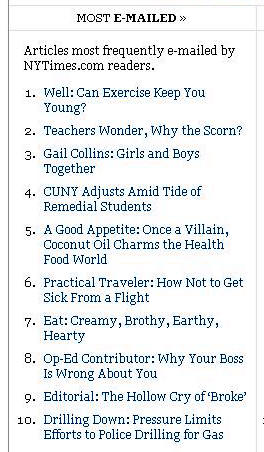
New York Times most e-mailed list this morning

The juxtaposition of numbers 2 (Teachers Wonder, Why the Scorn?) and 4 (CUNY Adjusts Amid Tide of Remedial Students) jumped out at me.  Teachers are baffled by the anger directed towards them (or, perhaps more accurately, towards their unions) while New York City colleges are dealing with the reality that fewer than one-half of high school graduates are prepared for college.  While teachers wonder, "why the scorn",  I wonder if most people believe that teachers have a significant impact on student learning.


Related:

How much does tutoring improve SAT scores?

My friend Catherine, after reviewing various meta-analyses, says this:
Students get about 30 points on average (across reading/math), with 8 points of that going to reading & the rest to math.
I don't think anyone has ever looked at the high-end tutors (there are families in NYC spending $25K to $40K for a year of SAT prep for one child).
Now that I'm in the thick of SAT prep, I believe the meta-analyses.
I don't see how anyone can coach the reading section, which is fantastically sophisticated, much beyond the 8-point average gain researchers find.
And 20 points on math sounds right to me, too, though we're trying for more.
30 points applied to the 1600-point SAT math and reading sections is confirmed in this report.
Test-prep programs generally include three elements: a review of test content, practice on test questions, and orientation to the format of the test. In 2009, in cooperation with NACAC, Mr. Briggs reviewed three national data sets and found the average effect of commercial coaching is positive, but slight. Test-score bumps were more in the neighborhood of 30 points (on a 1,600-point scale at the time), far from what some in the industry claim. He does point out that there may be specific programs that are more effective than others, but evidence to support that is weak.
My unscientific extrapolated estimate for the 2400-scale SAT would be that tutoring provides an average 45-points bump.

Thursday, March 3, 2011

New York State mandate relief report weak on specifics

The Torch provides some analysis on the Mandate Relief Redesign Preliminary Report to Governor Cuomo.
Late yesterday, the Mandate Relief Redesign Team — or, more accurately, its coaches and trainers in the governor’s office — issued a report that essentially punts the issue back to … the team itself.
The report was couched as “preliminary,” promising quarterly updates, to conclude with a final report a little over a year from now. “Going forward,” the report promises, “the Team will continue to review recommendations proposed by Team members, state agencies, local governments, school districts and the public, and consider them for advancement.”
In the meantime, the hopelessly divided “Team” seems destined to spend a lot more time scrimmaging around the 50-yard line.  The Triborough amendment and employee benefits, to cite just two factors driving up local costs, were mentioned by the report in passing, only as “complex issues” requiring further study.
Employee benefits must be the single most costly mandate issue desperately in need of repair.  The report's idea for a new pension tier seems to fall short of what is really needed.
Unfortunately, the language of the report steers carefully clear of mentioning the main problem with the current pension system: the unpredictability of taxpayer-funded employer contributions; the huge, open-ended financial risks imposed on taxpayers; and the repeated success of unions in clawing back reductions in benefits before any employee comes close to reaching retirement age. Those problems can only be addressed through a fundamental break with the defined-benefit pension system—by shifting to a defined-contribution retirement accounts or a hybrid pension plan. The Cuomo administration is, as yet, clearly unwilling to go that far. But it’s still not shutting the door, either.

Bronxville union contract limits health insurance* provider choices to two

According to this report, the Bronxville school district union contract allows for only two possible health insurance* providers, with one of those being an excessively costly option according to the state Comptroller's office.  Why limit choices to only two?
The state Comptroller’s office has released its audit of the Bronxville school’s spending during the 2009-10 school year, finding only one place where money could have been saved: health care.
The audit looked at health insurance benefits from July 1, 2005, through July 31, 2010, and determined the district could have saved about $1 million in the past three years if it had pulled out of a statewide consortium and found a cheaper plan on its own.
The district, in its response, said pulling out of the consortium would have cost $1.2 million in unrecoverable fund balance payments over the past three years and would have violated union contracts, which specifically named the consortium as one of two insurance providers.
However, the district said it would continue to monitor the consortium’s fund balances and demand repayment where applicable, and seek a seat on the consortium’s board of directors to increase oversight. The district also said it would continue to monitor its health care options to make sure it chooses the most cost-effective of the appropriate coverage options.
http://reviewpress.lohudblogs.com/2011/02/23/state-audits-bronxville-schools-healthcare-costs-could-be-less/

* Corrected

Wednesday, March 2, 2011

Bill Gates on how to get more value from our education dollars

Bill Gates wrote in the Washington Post:
Over the past four decades, the per-student cost of running our K-12 schools has more than doubled, while our student achievement has remained virtually flat. Meanwhile, other countries have raced ahead. The same pattern holds for higher education. Spending has climbed, but our percentage of college graduates has dropped compared with other countries.
To build a dynamic 21st-century economy and offer every American a high-quality education, we need to flip the curve. For more than 30 years, spending has risen while performance stayed relatively flat. Now we need to raise performance without spending a lot more....
Schools keep doing things that don't work.
The United States spends $50 billion a year on automatic salary increases based on teacher seniority. It's reasonable to suppose that teachers who have served longer are more effective, but the evidence says that's not true. After the first few years, seniority seems to have no effect on student achievement.
Another standard feature of school budgets is a bump in pay for advanced degrees. Such raises have almost no impact on achievement, but every year they cost $15 billion that would help students more if spent in other ways.
Perhaps the most expensive assumption embedded in school budgets - and one of the most unchallenged - is the view that reducing class size is the best way to improve student achievement. This belief has driven school budget increases for more than 50 years. U.S. schools have almost twice as many teachers per student as they did in 1960, yet achievement is roughly the same.
One proposal is similar to the "Gold Star Teacher" idea:
What should policymakers do? One approach is to get more students in front of top teachers by identifying the top 25 percent of teachers and asking them to take on four or five more students. Part of the savings could then be used to give the top teachers a raise. (In a 2008 survey funded by the Gates Foundation, 83 percent of teachers said they would be happy to teach more students for more pay.) The rest of the savings could go toward improving teacher support and evaluation systems, to help more teachers become
When he addressed the National Governors Association a few days ago, Bill Gates gave copies of Stretching the School Dollar: How Schools and Districts Can Save Money While Serving Students Best to audience members.  Many of the ideas are here.